Jamaat-e-Islami Hind, a Mirror of Society? Or A Subservient To The Government?
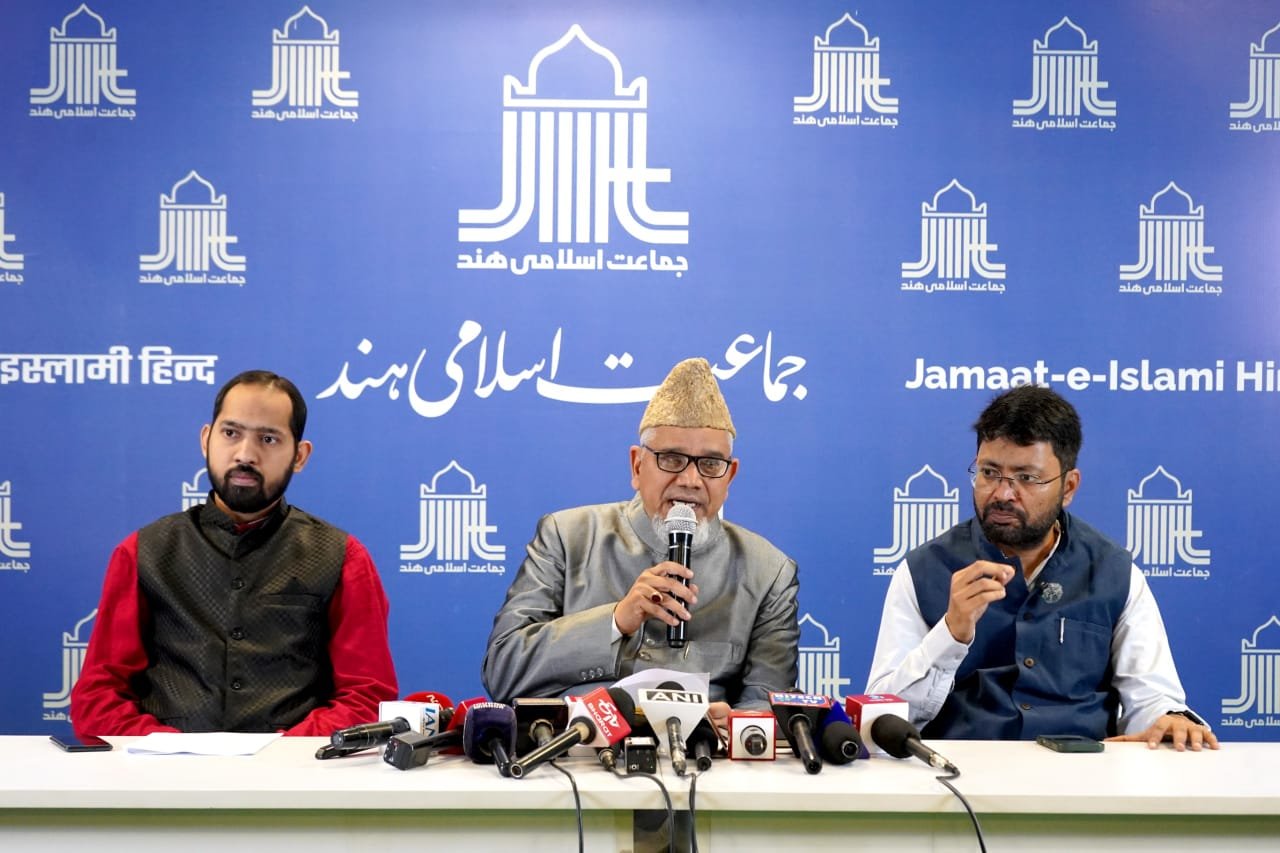
Jamaat-e-Islami Hind tells the same things to the journalists through press conferences which the whole world knows.


 Aina India News
Jamaat-e-Islami Hind tells the same things to the journalists through press conferences which the whole world knows.
S. Z. Mallick
New Delhi – Why doesn’t Jamaat-e-Islami Hind challenge the government? Why doesn’t it want to meet with the Prime Minister, Home Minister, or President with its delegation to raise the issues of its community? When journalists ask such questions, the Jamaat-e-Islami Hind responds, “We are conveying our message to the government through you.” So, is Jamaat-e-Islami Hind feeding journalists chicken biryani every month so that journalists will eat a plate of biryani and then convey their message through their media? Does Jamaat-e-Islami Hind hold journalists in such a low regard? Does Jamaat-e-Islami Hind consider journalists dogs, hoping to provoke the government with a plate of biryani? What kind of mentality does Jamaat-e-Islami Hind possess? And who knows how far have journalists stooped to their standards that they show up at their doorsteps every month to eat biryani? While they have plenty of issues to fight the government on, even for Muslim rights, they refuse to use them. Nor do they even want to share their policies with journalists. As an organization, they have to stage this drama every month to account for their expenses to the government; it’s their compulsion. They receive donations worth crores of rupees, so it’s obvious they have to show this much. While the RSS is funding its entire organization’s expenses from the Indian government’s treasury, and that too without registration, at least Jamaat-e-Islami is a registered organization. They’re not that dishonest; they certainly want to use journalists for free. But the RSS pays its journalists generously. Anyway, Jamaat-e-Islami Hind should change its policy regarding journalists. Anyway, let’s see what issue they held the press conference on, which the whole world is hearing. Did Jamaat-e-Islami Hind challenge the government in this conference?
For Read to any others News plz click below gives this link.
*Bihar Assembly Elections*
Jamaat-e-Islami Hind (JIH) calls upon the people of Bihar to participate in the upcoming Assembly elections in large numbers and exercise their democratic right with wisdom and responsibility. Voting is not merely a right but a sacred duty to strengthen democracy and build a just, peaceful, and developed society. The electorate should evaluate parties and candidates on their vision, performance, integrity, and commitment to solving people’s real problems — poverty, unemployment, education, health, and justice — rather than on emotional, divisive, or sectarian appeals. Jamaat-e-Islami Hind strongly urges all political parties to engage in a meaningful and constructive political discourse. Campaigns should focus on policies and public welfare instead of resorting to hate speech, communal polarization, or personal attacks. The use of money power, muscle power, or misuse of state machinery severely undermines democracy and erodes public faith in the electoral process. JIH also appeals to the Election Commission of India to ensure that the elections are conducted freely, fairly, and transparently, providing equal opportunity to all parties and candidates. Strict action must be taken against any violations of the Model Code of Conduct or attempts to influence voters through unfair means. Bihar has a proud legacy of political awareness and social harmony. Jamaat-e-Islami Hind believes that the people of Bihar will rise above divisive rhetoric and choose representatives committed to inclusive development, justice, and peace. The outcome of these elections should reflect the collective aspiration for a better Bihar and a stronger India.
*Rise in crimes against women*
Jamaat-e-Islami Hind (JIH) expresses grave concern and anguish over the series of recent sexual violence cases that have once again shaken the nation’s conscience and exposed the continuing vulnerability of women across India. In Phaltan, Satara district of Maharashtra, a woman government doctor was found dead in a hotel room, leaving a heart-rending note on her palm accusing a police officer and another man of repeated rape and harassment. This case, involving a victim who served the public, highlights the misuse of power and the failure of institutional mechanisms meant to protect women from abuse and intimidation. In New Delhi, a hospital employee was allegedly raped by a delivery boy who posed as an Army officer on social media, sending her uniformed photographs to gain her trust. The incident is a chilling example of digital deceit and manipulation, showing how online platforms are being weaponized against unsuspecting women. And in another recent case from Delhi, an 18-year-old MBBS student accused a friend of drugging, raping, and blackmailing her after a hotel party, exposing how misuse of alcohol, trust, and technology can combine to exploit young women in urban settings. These cases occurring within universities, hospitals, government offices, and homes are not isolated tragedies. They represent a pattern of everyday insecurity faced by Indian women, irrespective of education or profession. The latest Crime in India 2023 report by the National Crime Records Bureau (NCRB) confirms the disturbing trend. With 4,48,211 cases of crimes against women registered in 2023, the figures show a continuing rise over the previous year. Rajasthan once again recorded the highest rate among states, while Delhi topped among Union Territories, underscoring that both urban and rural India continue to struggle with gender-based violence. The data includes acts of cruelty by husbands and relatives, sexual assault, trafficking, and violations under the Protection of Women from Domestic Violence Act. All this is also indicates a society where moral restraint and empathy are steadily eroding, and where predators often act with a sense of impunity. Jamaat-e-Islami Hind urges the central and state governments to take urgent and concrete measures to combat the rising tide of sexual violence against women by ensuring speedy trials and victim-centred justice in all cases, and by implementing comprehensive gender-sensitivity training for the police, judiciary, and healthcare workers. Yet, beyond these administrative steps, the overall pattern points to a grave moral and social breakdown that laws alone cannot repair. JIH firmly believes that this crisis is not merely a failure of policing or justice delivery, but a reflection of deeper spiritual and ethical decay within society. We therefore call upon all concerned citizens to become proactive in ensuring safety, respect, and justice for every girl and woman in India, and to rethink our collective approach towards the menace of sexual harassment and sexual crimes. Strict laws must go hand in hand with a moral reformation of society. Jamaat-e-Islami Hind emphasizes that the problem of sexual crimes against women must be addressed comprehensively—through stringent laws, speedy trials, and exemplary punishment for perpetrators, coupled with a parallel movement for moral regeneration. Unless the values of fear of God and accountability in the Hereafter are internalized by individuals, the exploitation and degradation of women will persist, corroding the very soul of our humanity.
*Anti CAA Political Prisoners Case*
Jamaat-e-Islami Hind (JIH) expresses great disappointment and serious concern at the continued incarceration of those accused in the 2020 Delhi riots conspiracy case. Innocent students and Anti CAA activists have now spent nearly five years in custody without the commencement of a proper trial. Such prolonged pre-trial detention effectively amounts to punishment through process, undermining the foundational legal principle that bail is the rule and jail the exception.
The Supreme Court of India has deferred the hearing of the bail pleas to Monday, prolonging the uncertainty that already weighs heavily on the accused and their families. Even more troubling is the Delhi Police’s vehement opposition to bail, including its characterization of the 2020 riots as an alleged “regime change operation.” Such rhetoric, coming from a state agency, raises grave concerns about fairness, objectivity, and proportionality, and appears to prejudice the case in the public mind before the courts have had the opportunity to assess evidence.
JIH finds the continued invocation of UAPA against student activists, researchers, and civil society members who had participated in peaceful anti-CAA protests deeply disturbing. In the absence of any weapons recovery, overt act of violence, or direct evidence of incitement, treating WhatsApp group membership, speech excerpts, or protest coordination as evidence of conspiracy stretches the meaning of “terrorism” beyond recognition. Such interpretations risk criminalising dissent and delegitimising democratic protest, which are both protected under the Constitution of India. Equally worrisome is the inconsistency in the approach of the judiciary in this case. While some co-accused have been granted bail, others like Umar Khalid, Khalid Saifi, Gulfisha, Meeran, Sharjeel Imam and several others continue to remain behind bars. This selective treatment and the apparent political overtones in prosecution arguments cast a long shadow over the perception of impartiality and parity before law. Broad and unsubstantiated assertions of “defaming the nation” or “creating communal division” cannot substitute for credible, concrete evidence. The ongoing detention of peaceful protesters sends a chilling message to all citizens, particularly students, minorities, and human-rights defenders that exercising one’s democratic right to dissent may invite indefinite imprisonment. It is equally distressing that while the real perpetrators of the violence in North-East Delhi remain unpunished, those who had merely voiced disagreement with a controversial law continue to languish in prison.
Jamaat-e-Islami Hind calls upon the Supreme Court to deal with this matter on priority, to uphold the spirit of justice and constitutional freedoms. JIH urges all authorities, legislative, executive, and judicial to ensure that justice is dispensed impartially, transparently, and free from political influence. We reiterate that the freedom of dissent is the lifeblood of democracy, and its suppression endangers the very fabric of the Republic. Only through a firm commitment to rule of law, fair trial, and equal protection of rights can India preserve the ideals enshrined in its Constitution and maintain public faith in its institutions of justice.
इससे सम्बंधित खबरों के लिए नीचे दिए गए लिंक पर क्लिक करें 👉🏽http://www.mpnn.in
Did Jamaat-e-Islami Hind challenge the government in this conference? Did it make any appeal to the public? Did the Jamaat-e-Islami clarify any of its policies? So, tell me, what’s the point of holding this conference? Just think about it???














No Comments: